
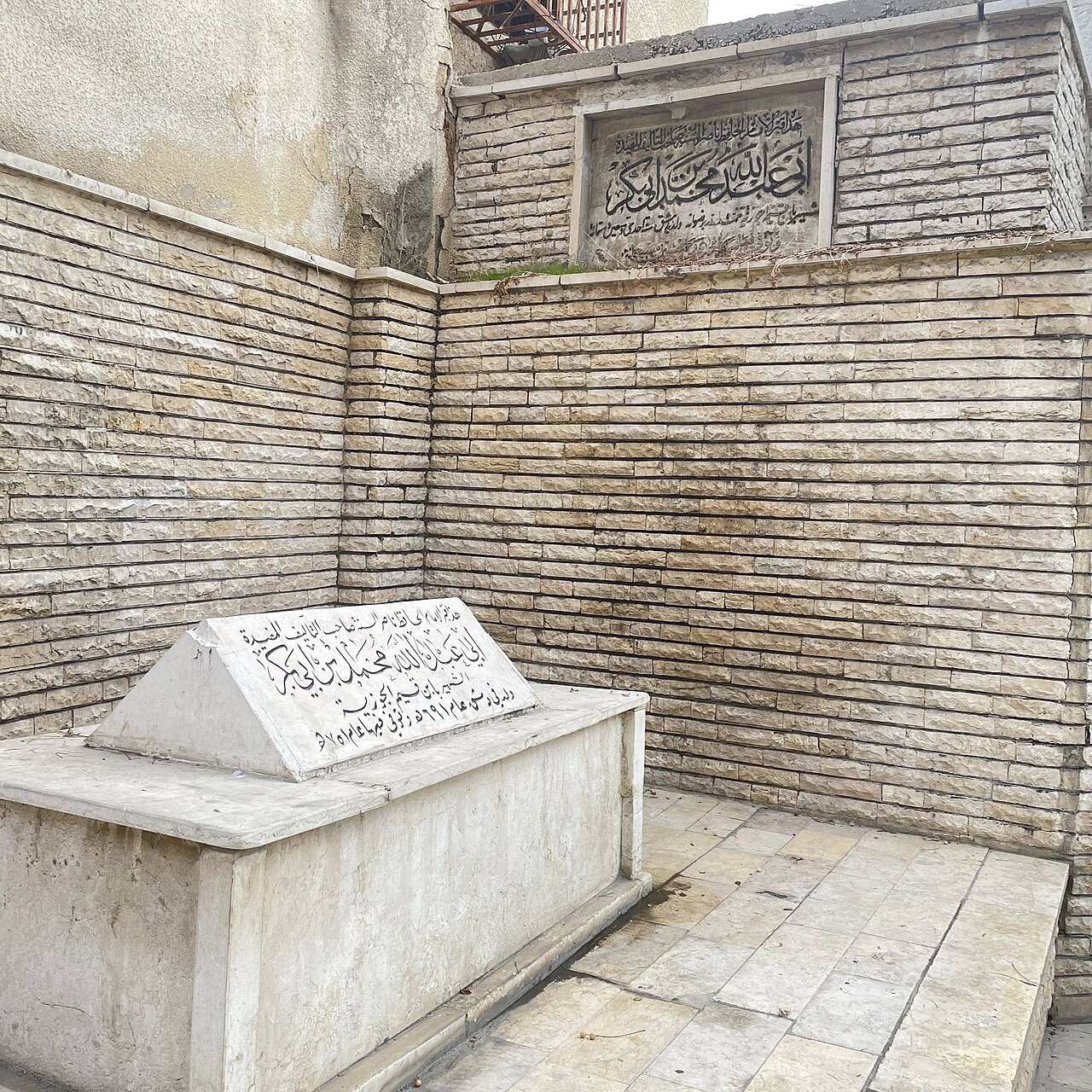
Ibn Qayyim al-Jawziyya
Hanbali jurist, theologian, and spiritual writer.

Threethalatha · CC0
His prolific corpus of doctrinal and literary works influenced many later scholars, and his name remains controversial due to his popularity among Salafists, who see his criticisms of Sufi practices as a classical precursor to their own views.
- field
- Islamic jurisprudence, theology, spirituality
- nationality
- Syrian Arab
- known_for
- Foremost disciple of Ibn Taymiyya; prolific Hanbali scholar; critic of saint veneration and astrology
Lore & Background
Ibn al-Qayyim was born in Damascus to a father who was principal of the Jawziyyah Madrasah, a Hanbali law college. This 16-year association shaped many of his views, though his approach was less polemic. While in prison, he delved into the Qur'an, experiencing mystical states described as dhawq and mawjud.
Reader's Guide
Ibn al-Qayyim's significance lies in his extensive writings on jurisprudence, theology, and spirituality, which influenced major Mamluk-era scholars such as Ibn Kathir, Ibn Rajab, and Ibn Hajar al-Asqalani. In jurisprudence, he supported broad state powers, arguing that lowly-status individuals could be punished for accusing the respectable, and formulated evidential theories reducing reliance on oral testimony, such as paternity determination by facial similarity and impotence testing via boiled semen. He also believed testimony could be beaten from disreputable suspects, contrary to earlier Islamic jurists who forbade torture. He opposed astrology and alchemy, using empirical arguments to refute them. Despite modern characterization as an enemy of mysticism, he had great interest in Sufism, writing major works on Sufi themes, including a commentary on Abdullah Ansari's treatise, and addressing matters of the heart for Sufis and scholars alike. His legacy is controversial due to his popularity among Salafists, who cite his criticisms of saint veneration and grave visitation.
Did You Know?
- He argued that a husband's impotence could be determined by boiling a sample of his ejaculate; only genuine semen left a white residue.
- He wrote a lengthy spiritual commentary on a treatise by the Hanbali Sufi Khwaja Abdullah Ansari, calling Ansari 'Sheikh al-Islam'.
- His father was the principal (qayyim) of the Jawziyyah Madrasah, a Hanbali law college in Damascus.
Scholar of the Classical Tradition
Ibn Qayyim al-Jawziyya, who died in 751 of the Hijri calendar (1350 C.E.), occupies a distinctive place in the lineage of Islamic intellectual history. He is consistently invoked alongside Ibn Taymiyya (d. 728 A.H./1328 C.E.) as a foundational voice in a particular strand of Sunni theological thought, and the two names appear together as a paired authority in the minds of later reformers. What distinguishes Ibn Qayyim's historical significance is not the biographical events of his own lifetime but the treatises he bequeathed to subsequent generations. Those writings carried sufficient doctrinal force and rhetorical clarity to serve as a primary wellspring for reform movements that would not emerge for more than three centuries. In the broader arc of Islamic scholarship, he functions as a classical authority whose ideas were transmitted, debated, and ultimately mobilized by preachers and jurists seeking to reassert what they regarded as the most authentic forms of worship and community life. His consistent pairing with Ibn Taymiyya suggests that his treatises addressed overlapping concerns—scriptural primacy, the rejection of inherited innovation, and the absolute centrality of divine oneness—that together constituted a coherent and enduring theological framework.
The Theological Center: Tawhid
At the core of Ibn Qayyim al-Jawziyya's intellectual contribution, as it is understood through his downstream influence, lies the doctrine of tawhid—the absolute, uncompromised oneness of God. This principle was never merely an abstract metaphysical assertion; rather, it operated as the governing criterion for evaluating every religious custom, legal ruling, and social institution. When the eighteenth-century Najdi scholar Muhammad ibn Abd al-Wahhab articulated his vision for returning Muslim communities to unmediated scriptural practice, he explicitly drew upon the treatises of Ibn Qayyim alongside those of Ibn Taymiyya. The emphasis on tawhid in Ibn Qayyim's work provided the doctrinal scaffolding for arguments against practices deemed to compromise divine uniqueness, including the veneration of saints' shrines and the uncritical reliance on inherited legal interpretations rather than direct engagement with the Quran and Hadith. In this framework, tawhid becomes a practical lens through which every aspect of communal life is assessed. Ibn Qayyim's treatises thus functioned as a theological compass, orienting later reformers toward a vision of worship and social order organized exclusively around the sovereignty of God.
Intellectual Catalyst for Eighteenth-Century Reform
The treatises of Ibn Qayyim al-Jawziyya exercised a formative influence on Muhammad ibn Abd al-Wahhab (1703–1792), the scholar from central Arabia who became the eponymous figure of the reform movement later labeled Wahhabi. Ibn Abd al-Wahhab's program of social and religious renewal was, by intellectual lineage, deeply shaped by the writings of Ibn Qayyim and Ibn Taymiyya. This connection reveals that the eighteenth-century reform effort was not an isolated phenomenon but the activation of a classical theological vocabulary. Ibn Qayyim's emphasis on returning directly to the Quran and Hadith, his critique of blind imitation (taqlid) of medieval legal manuals, and his insistence on independent legal reasoning (ijtihad) all found a powerful echo in the teachings of his later follower. The young Najdi scholar, during his formative travels to Medina and his tutelage under the Naqshbandi teacher al-Sindi, was encouraged to reject rigid adherence to established madhhab systems and to develop personal research of scriptures—precisely the intellectual trajectory that Ibn Qayyim's classical treatises had already charted. In this sense, Ibn Qayyim functioned as a vital bridge between the medieval scholarly world and the modern reformist impulse.
A Legacy Spanning Centuries
The enduring reach of Ibn Qayyim al-Jawziyya's intellectual legacy is perhaps best measured by the vast temporal distance between his death in 1350 C.E. and the political-religious transformations his treatises helped to catalyze in the late eighteenth century. The alliance between Muhammad ibn Abd al-Wahhab and Muhammad bin Saud, which produced the Emirate of Diriyah and the first Saudi state, was undergirded by a theological vision that traced its intellectual ancestry directly to Ibn Qayyim and Ibn Taymiyya. The descendants of Ibn Abd al-Wahhab, the Al ash-Sheikh family, went on to dominate the clerical institutions of the Saudi state for generations, meaning that the doctrinal priorities embedded in Ibn Qayyim's classical writings—scriptural primacy, the rejection of religious innovation, and the centrality of tawhid—became institutionalized within a governing religious establishment. Even critics who rejected Ibn Abd al-Wahhab's specific positions, including certain Hanbali scholars of his own era, operated within a discursive space that Ibn Qayyim's earlier treatises had helped to define. His influence thus extended well beyond any single movement, shaping the parameters of theological debate across the Sunni world for centuries after his passing.
Gallery





Frequently Asked Questions
What are Ibn Qayyim al-Jawziyya's major areas of work?
His prolific body of writings spans legal theory, theological argumentation, and spiritual literature, all rooted in the Hanbali juristic tradition. He is particularly noted for his critiques of saint veneration and astrological practices within Islamic culture.
Why does Ibn Qayyim al-Jawziyya remain controversial?
His sharp criticisms of Sufi practices and popular religious customs have made him a key reference point for Salafi movements, who view his positions as a classical foundation for their own reformist stance. This has also drawn pushback from scholars who see his views as overly restrictive.
More in Islamic Scholars & Sages 1-21
Spotted an error? Know more?
This is a living reference — every entry is fact-audited, and reader corrections feed straight into our audit queue. Suggest an edit · See this site's audit record